Categories
Understanding Property Ownership in Ontario: Joint Tenancy and Tenancy in Common
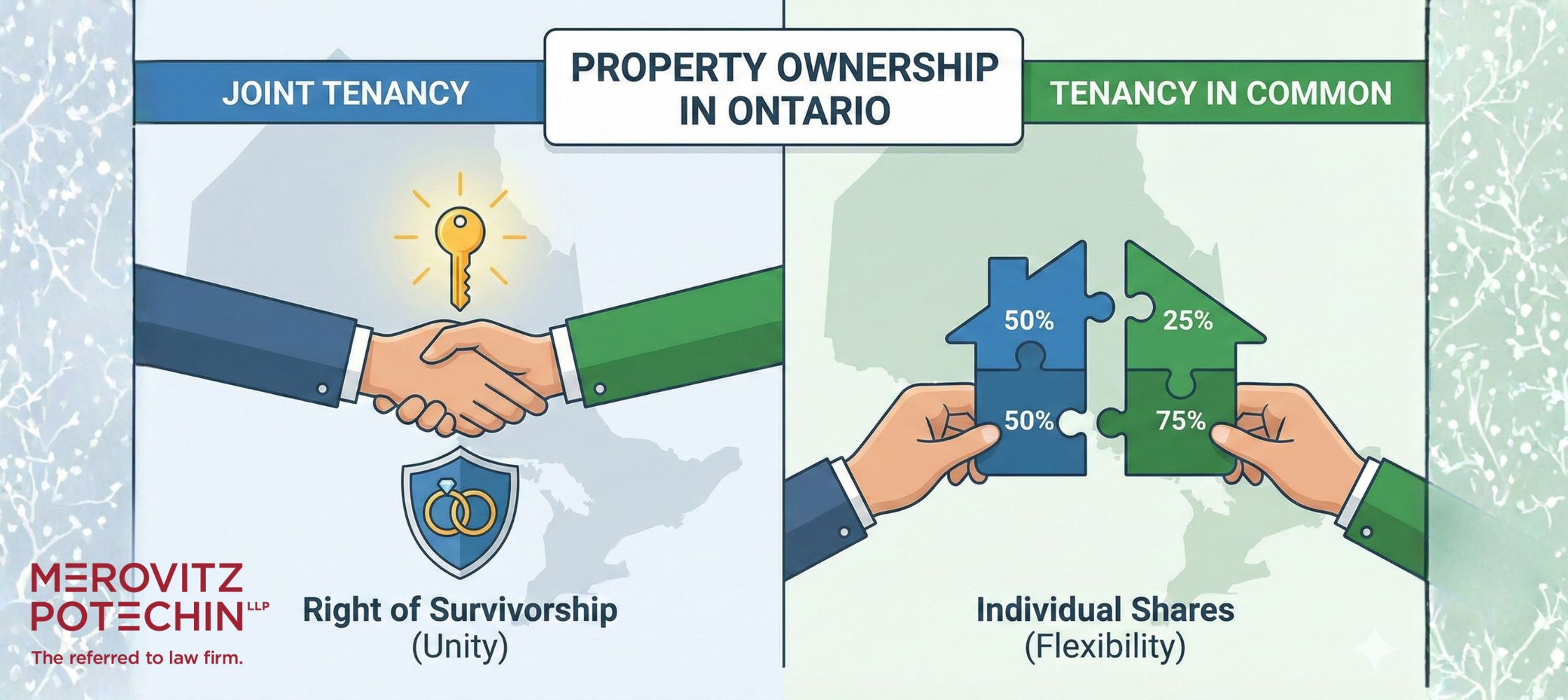
When comparing joint tenancy vs tenancy in common, Ontario property buyers should know that ownership can be structured in one of three ways: (1) joint tenancy, (2) tenancy in common, or (3) a combination of both. Registering ownership on title is not just a technicality. It creates significant legal and estate planning consequences when buying property together.
Assuming you own the property personally and not through a company, your chosen structure dictates what happens if an owner dies. It controls how you can sell or refinance the property. Finally, it determines who inherits your share.
The correct choice depends entirely on personal circumstances and often requires input from professional advisors such as an accountant. Below is an overview of each ownership structure. This will help you make an informed decision when buying with others.
Joint Tenancy
Joint tenancy is when all owners hold an equal interest in the entire property. Spouses or partners most commonly use this structure to ensure the survivor automatically inherits the property.
Under joint tenancy, you do not register specific ownership percentages on title. Each owner owns the entire property together with the others. The defining feature of joint tenancy is the right of survivorship. This means when one owner dies, their share automatically transfers to the survivor(s).
The deceased owner’s interest bypasses their will and estate entirely. As a result, the property generally avoids probate on the first owner’s death. This also saves you from Ontario’s probate tax, which is roughly 1.5% of the asset’s value.
Benefits of Joint Tenancy
- Avoids probate on death: The right of survivorship allows ownership to transfer automatically to the surviving co-owner(s), avoiding delays and probate fees.
- Equal control and ownership: Joint tenancy treats all owners as equal which can be ideal for spouses or long-term partners.
Drawbacks of Joint Tenancy
- No flexibility in ownership percentages: Ownership shares cannot be adjusted to reflect unequal financial contributions (for example, a 60/40 split registered on title).
- No ability to leave your share by will: A joint tenant cannot leave their interest in the property to someone other than the surviving joint tenant(s).
Joint tenancy is generally a good choice if you want your share to pass automatically upon death. This ensures the surviving owners avoid probate.
Tenancy in Common
Tenancy in common allows each owner to hold a specific percentage interest in the property, and specifically register that interest on title. For example, one owner may hold a 25% interest while another holds 75%. If no percentage is specified, there is a presumption that the tenancy in common is in equal shares.
This structure is useful for when owners contribute different amounts toward the purchase price. A common example involves a parent assisting an adult child with qualifying for a mortgage. The parent may be registered on title as a 1% owner solely for financing purposes, without intending to benefit from the property.
As a result, the child owns a 99% interest in the real property. However, it is crucial to understand the risks of this arrangement. Even though the parent holds a mere 1% share, they may still be liable for the entire mortgage. In other words, a small ownership percentage does not limit your financial liability to the lender.
When a tenant in common dies, their ownership interest does not pass automatically to the other owners. Instead, it becomes part of their estate and is distributed according to their will (or the rules of intestacy if there is no will) and is generally subject to probate tax.
Benefits of Tenancy in Common
- Flexible ownership percentages: Ownership can reflect each party’s financial contribution, which is optimal for friends, investors or financing approval.
- Estate planning control: Owners may leave their share of the property through their will to anyone they choose, such as children or other beneficiaries.
Drawbacks of Tenancy in Common
- No right of survivorship: The deceased owner’s share must pass through probate, potentially resulting in delays and probate taxes.
- Potential for disputes: Separate ownership interests can create decision making challenges, particularly where expectations are not aligned.
Tenancy in common is generally a good choice if you do not want your share of the property to pass automatically to your co-owner upon death, or if there has been an unequal financial contribution at the time of acquisition. As a result, this type of ownership is often used for business transactions (rather than close family relationships).
Mixed Ownership: Combining Joint Tenancy vs Tenancy in Common Ontario
In certain circumstances, a combination of joint tenancy and tenancy in common may be appropriate where there are three or more owners.
For example, two couples may purchase a property together. Each couple may want to hold their interest as joint tenants between themselves, while the two couples hold their interests as tenants in common with each other. In this scenario, if one spouse dies, their interest would pass to the surviving spouse without affecting the ownership interest of the other couple.
This approach allows owners to have their preferred estate planning outcomes while still sharing ownership with others.
Final Thoughts on Joint Tenancy vs Tenancy in Common Ontario
Choosing between joint tenancy and tenancy in common is not a one size fits all decision. It requires careful consideration of several factors, including:
- whether financial contributions are equal;
- what you want to happen to your share of the real property on death;
- your relationship with the other owners; and
- your estate planning goals.
Discussing these issues openly with your co-owners and reviewing your options with an estate planning or real estate lawyer will ensure that your ownership structure aligns with your goals and avoids negative consequences down the road.
The content on this website is for information purposes only and is not legal advice, which cannot be given without knowing the facts of a specific situation. You should never disregard professional legal advice or delay in seeking legal advice because of something you have read on this website. The use of the website does not establish a solicitor and client relationship. If you would like to discuss your specific legal needs with us, please contact our office at 613-563-7544 and one of our lawyers will be happy to assist you.